by Wahdatuss Saufiyah Binti Khalil Hasharie, an Internship student from University of Manchester
When people hear the word “antibiotics”, they usually think of medicines used to treat bacterial infections. Antibiotics have saved countless lives over the decades due to their ability to treat various bacterial infections such as tuberculosis, pneumonia, and sepsis. Antibiotics have made an undeniable contribution to medicine today. However, what if medicines used to fight bacterial infections also have the potential to influence another aspect of our health, particularly the effectiveness of cancer treatment?
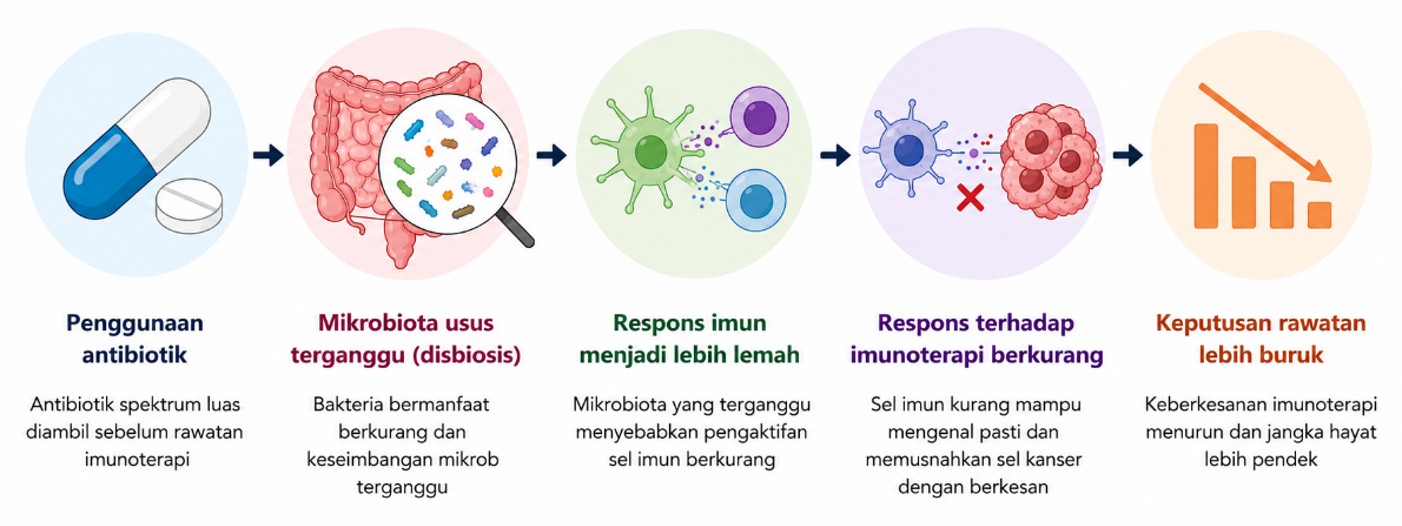
In recent years, scientists have started to investigate the link between antibiotics and cancer treatment. Studies have shown that the gut microbiota, which is the community of microorganisms that naturally live in our digestive system, plays an important role in the efficacy of certain cancer treatments, particularly immunotherapy. Although antibiotics are used to kill harmful bacteria in the body, they can also harm beneficial bacteria in the digestive system by disrupting their balance. This imbalance is known as dysbiosis, which may affect immune system function and alter the body’s response to cancer treatment.
Unlike chemotherapy drugs that work by directly destroying cancer cells, immunotherapy treatments help the body’s immune system to recognize and destroy those cancer cells more effectively. However, not all cancer patients respond well to immunotherapy. Therefore, scientists have begun investigating whether differences in the gut microbiota population could be one of the factors influencing treatment response. Since antibiotics can disrupt the gut microbiota by reducing beneficial bacteria and altering the microbial balance, they may weaken immune responses and potentially reduce the effectiveness of immunotherapy.
This idea was supported by a study conducted by scientists at Imperial College London, who examined nearly 200 cancer patients receiving immune checkpoint inhibitors, a type of immunotherapy. The scientists found that patients who had received broad-spectrum antibiotics, capable of eliminating a wide range of bacteria, a few days before starting immunotherapy experienced poorer treatment outcomes. This was supported with clear evidence from CT scans showing that tumors grew more rapidly compared to those who had not received antibiotics. They suggested that antibiotic use may reduce populations of beneficial gut microbiota. This may potentially weaken immune responses that are important for immunotherapy to function effectively.
The results were consistent regardless of the type of antibiotic taken by the patients or the type of cancer they had. Among lung cancer patients, who tend to suffer from chest infections, the median survival for those who had received antibiotics before immunotherapy was only 2.5 months compared to 26 months for those who did not receive antibiotics. Similar results have also been reported in other studies investigating the role of the gut microbiota in cancer treatment. Two studies published in the journal Science in 2017 reported that cancer patients with certain types of gut microbiota responded better to anti-PD1 immunotherapy. The scientists suggested that specific gut microbiota may enhance anti-tumour immune responses. These findings emphasize the importance of maintaining a healthy and diverse gut microbiota to support better cancer treatment.
Nevertheless, it is worth keeping in mind that antibiotics are still necessary and life-saving medications that cannot be ignored when needed. Cancer patients are more susceptible to bacterial infections because both the cancer itself and its treatment can weaken the immune system. In these situations, antibiotics may be necessary to treat bacterial infections and protect patients from potentially serious complications. Therefore, the decision to use antibiotics should always be based on medical need and guided by a healthcare professional.
Thus, these studies do not suggest that antibiotics should be avoided during cancer treatment. Instead, they emphasize the importance of understanding how medicines and biological systems interact within the body. The study of microbiota in the gut of cancer patients has shifted the focus of cancer research. Rather than focusing solely on the cancer itself, scientists are recognizing that successful cancer treatments may also rely on the body’s internal environment. As research in this area continues to develop, these new ideas regarding the relationship between antibiotics, the gut microbiota, and the immune system may enable scientists to develop more effective and personalised cancer treatments in the future.
References:
- Gopalakrishnan, V. et al. (2017). Gut microbiome modulates response to anti–PD-1 immunotherapy in melanoma patients. Science, 359(6371), pp.97–103. https://doi.org/10.1126/science.aan4236.
- Pinato, D.J. et al. (2019). Association of prior antibiotic treatment with survival and response to immune checkpoint inhibitor therapy in patients with cancer. JAMA Oncology, 5(12), p.1774. https://doi.org/10.1001/jamaoncol.2019.2785.
Routy, B. et al. (2017). Gut microbiome influences efficacy of PD-1–based immunotherapy against epithelial tumors. Science, 359(6371), pp.91–97. https://doi.org/10.1126/science.aan3706.
Date of Input: 08/07/2026 | Updated: 29/08/2026 | azah
MEDIA SHARING