By Dr. Norsharina Ismail
Polygonum minus (P. minus) is a tropical herb that has been part of traditional practices in Southeast Asia for many years. It belongs to the Polygonaceae family and grows widely in countries such as Malaysia, Indonesia, and Thailand. In Malaysia, it is commonly known as kesum, a familiar herb used in traditional cooking. One of the most noticeable features of P. minus is its pleasant, sweet aroma. Because of its distinctive fragrance and flavour, the herb is often used as a natural ingredient to enhance the taste and aroma of food. However, its value goes beyond the kitchen. Researchers have become increasingly interested in this plant because it contains a variety of natural compounds that may have beneficial properties for food preservation, agriculture, and human health.
Traditionally, P. minus has been used as a natural remedy for several health complaints. These include fungal infections, poor eyesight, and body aches. Although traditional uses do not automatically mean that a treatment has been scientifically proven to work, they provide an important starting point for researchers investigating the plant's potential health benefits. One reason P. minus has attracted scientific attention is its antioxidant activity. Antioxidants are substances that can help protect cells and food components from damage caused by unstable molecules known as free radicals. This property may make P. minus useful in the food industry. For example, extracts from the plant could potentially be used as natural food additives to slow down oxidation, a process that can cause foods to lose their quality, flavour, colour, and freshness.
The plant may also help protect food from harmful microorganisms. Because P. minus has antimicrobial properties, researchers have explored its use in edible films and coatings. These are thin layers made from food-safe materials that can be placed around food to provide an additional protective barrier. Such applications could potentially help reduce microbial contamination and extend the shelf life of certain foods, while reducing reliance on some conventional preservatives.
The potential benefits of P. minus are not limited to food. The plant has also attracted interest from the agricultural and animal industries. In livestock, poultry, and aquaculture, researchers are exploring plant-based alternatives to conventional growth-promoting substances. P. minus may have potential in these areas because of its biological activities, including possible anti-parasitic effects. Such applications could contribute to the development of more natural approaches to maintaining animal health and supporting production.
In the field of human health, studies have investigated the possible protective effects of P. minus on different body systems, as well as its ability to inhibit certain microorganisms. These findings suggest that compounds found in the plant may have potential for future development as health-promoting ingredients or as sources of new therapeutic compounds. However, it is important to recognise that promising laboratory findings do not necessarily mean that the plant or its extracts can be used directly as a medical treatment. More research, including well-designed studies on safety, effectiveness, dosage, and long-term use, is needed before such applications can be confirmed.
Another exciting area of research is the combination of P. minus with nanotechnology. Nanotechnology involves working with extremely small particles and materials. In plant-based products, these technologies may help improve how certain natural compounds are delivered, absorbed, or used by the body. This could potentially increase the effectiveness and bioavailability of useful compounds obtained from P. minus.
Overall, P. minus is much more than an aromatic herb commonly used in Southeast Asian cuisine. Its traditional uses, natural chemical compounds, antioxidant and antimicrobial properties, and potential applications in food, agriculture, and healthcare make it an interesting subject for scientific research (Figure 1).
This review brings together current knowledge about P. minus, including its traditional uses, natural compounds, safety considerations, and potential applications. By better understanding this locally available tropical herb, researchers may uncover new opportunities to develop natural and sustainable products for food preservation, agriculture, and health. At the same time, continued research is essential to ensure that these potential benefits are supported by reliable scientific evidence and that products developed from the plant are safe and effective for wider use.
Source of article: Zhongming Yang, Xi Deng, Zhongguo Yang, Mingzhao Han, Norsharina Ismail, Kim Wei Chan, Ahmad Faizal Abdull Razis, Norhaizan Mohd Esa, Ket Li Ho, Md Zuki Abu Bakar. Polygonum minus: A tropical medicinal herb with vast applications in food, agricultural, and medicinal fields. Food Bioscience 60 (2024) 104511. https://doi.org/10.1016/j.fbio.2024.104511
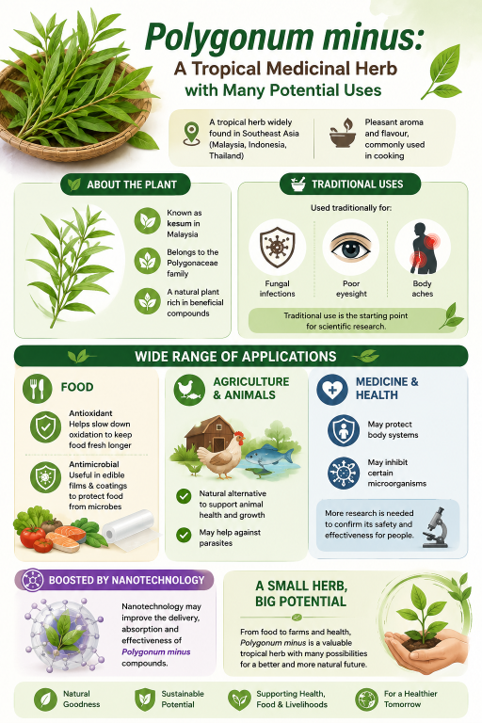
Figure 1. Potential applications of Polygonum minus (P. minus), a tropical medicinal herb. P. minus, commonly known as kesum in Malaysia, is an aromatic herb widely found in Southeast Asia. Traditionally used for various health-related purposes, P. minus contains natural compounds with antioxidant and antimicrobial properties. These properties support its potential applications in food preservation, agriculture and animal health, and medicinal and health-related research. Emerging approaches such as nanotechnology may further improve the delivery, absorption, and effectiveness of its beneficial compounds. Overall, P. minus represents a promising tropical plant resource with diverse applications, although further research is needed to confirm its safety and effectiveness.
Date of Input: 29/08/2026 | Updated: 29/08/2026 | azah
MEDIA SHARING